





Green building envelope
Contents |
[edit] Introduction
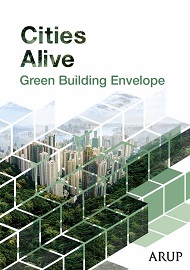
In September 2016, Arup published ‘Cities Alive: Green Building Envelope’, a report examining the possibilities of cleaner, greener and healthier human ecosystems.
The report, written by a global collaborative team of Arup specialists, explores the application of green infrastructure to the surfaces of both new and existing inner-city buildings in five major cities; Berlin, London, Los Angeles, Melbourne and Hong Kong.
The wide-ranging conclusions of the report include:
[edit] Air pollution
- Green facades can reduce local air pollution by 10-20%.
- The level of reduction is dependent on the ratio of the building height to the street width.
[edit] Acoustics
- Green facades could reduce sound levels from emergent and traffic noise sources by up to 10dB(A).
- Green facades have a greater acoustical impact with increasing distance from the noise source.
- When ambient noise levels are lower, such as during the night, green facades are likely to have a greater acoustic impact.
[edit] Urban heat island (UHI) effect
- Green facades can remove 50% of solar radiation.
- They are most effective at reducing the UHI in denser urban centres and in areas where there is more concrete and less planting.
- Reductions in peak air temperatures of up to 10ºC are achievable, although for most areas, the mean reductions in UHI were a fraction of a degree compared to the peak.
- Cities with wide streets and low-rise buildings could benefit from more greenery at street level.
To download the full report for free, see Arup.
[edit] Find out more
[edit] Related articles on Designing Buildings Wiki
Featured articles
Check out some of the best features and news from Designing Buildings as well as key stories from around the web.

Updated supplier guide can help electrical contractors engage with NHP.

CIAT confirm the winners of the 2026 architectural technology awards.

Government launches a one stop shop for flood preparedness.

Sir Edwin Lutyens: Britain's greatest architect? Book review.

CIOB publishes free template to help assess and manage risks.
ECA's reflections on Party Conference season

Burnham wants to be confident of winning before asking for a fresh mandate.
New Chief Construction and Scientific Adviser

Sergio Cavalaro, Professor of Infrastructure Systems at Loughborough University.
Building safety levy for England

CIAT publish estimator tool for members.

Water sector faces a growing crisis that could slow the delivery of vital infrastructure.
Undervaluing our industrial past

Heritage value changes as taste for building styles changes.
Changing expectations around competence and compliance

New information sheet from CIAT.
Grenfell investigation files passed to CPS

Angela Rayner apologises on behalf of the British state.